
Misha Donat
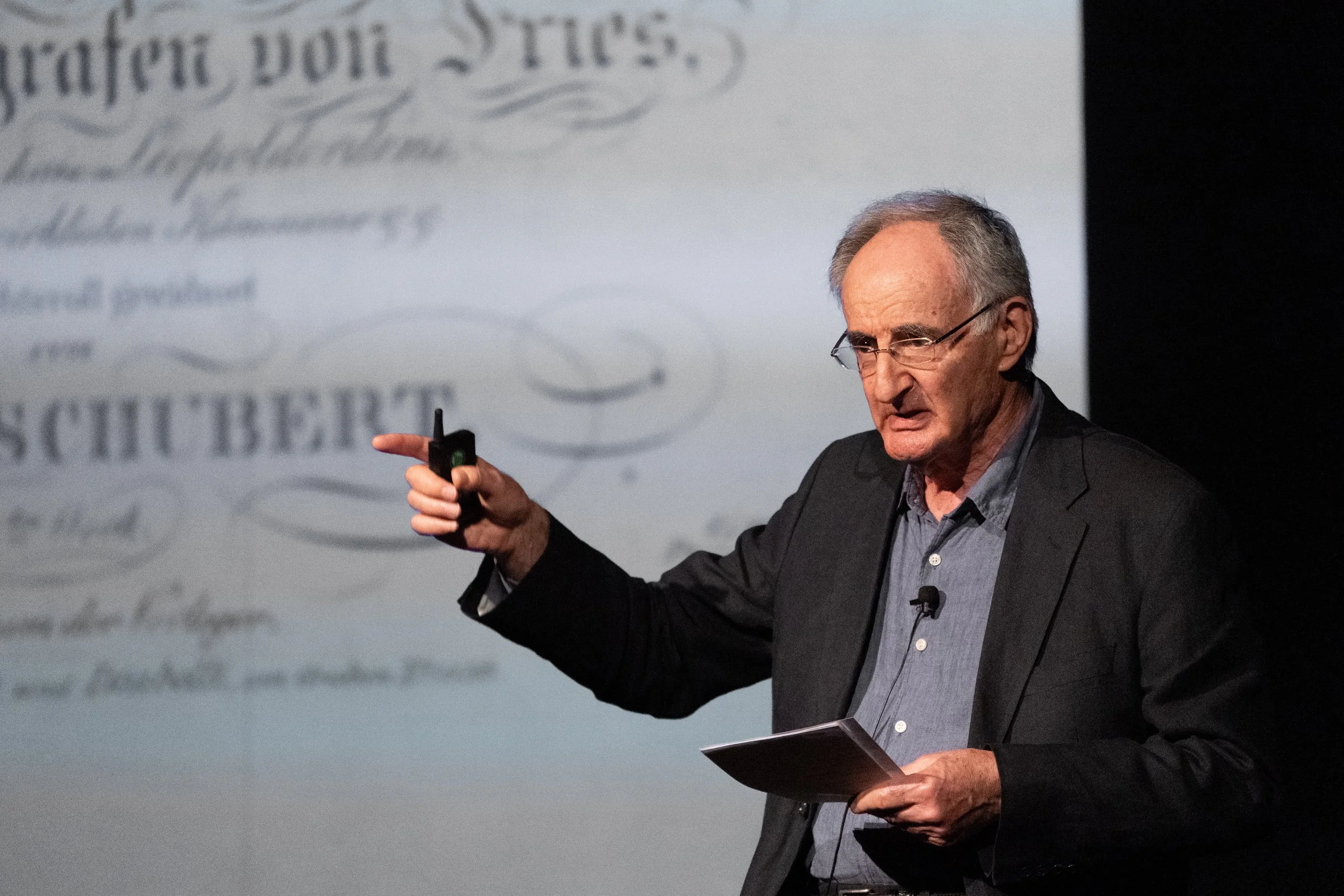
Misha Donat is a distinguished British music writer, critic, broadcaster, producer, lecturer and translator, whose career has encompassed more than five decades of work at the highest levels of classical music. A noted authority on Beethoven and the Classical and Romantic repertoire, he is particularly admired for combining scholarly depth with an unusually lucid and accessible approach to writing about music.
Donat began his professional life as a composer, writing music for theatre and cinema, including films directed by Lindsay Anderson and Albert Finney. He subsequently joined BBC Radio 3, where he spent more than twenty-five years as a senior music producer, working with many of the world’s leading musicians. Among his responsibilities was the planning and production of the BBC’s prestigious lunchtime concert series at St John’s, Smith Square, and he also established a Young Artists’ Forum designed to introduce outstanding musicians of a new generation.
Following his BBC career, Donat worked for several years as a producer for the Philharmonia Orchestra, overseeing major recording projects with some of the foremost conductors of the period. These included Mahler and Schoenberg recordings with Esa-Pekka Salonen, Brahms and Schumann cycles with Christoph von Dohnányi, and a cycle of Mahler symphonies conducted by Lorin Maazel. From 2017 to 2024, he was Artistic Director of Norwich Chamber Music.
Alongside his work as a producer, Donat has developed an extensive career as a writer and critic. His articles have appeared in The London Review of Books, The Guardian, The Musical Times and other publications, and he has written programme notes for many of Britain’s leading musical institutions, including Wigmore Hall, London’s South Bank, and the Aldeburgh, Edinburgh and Brighton festivals. He has also written extensively for the recording industry, contributing booklet essays to releases by Decca, Deutsche Grammophon, RCA, Philips, Hyperion and other major labels. His recent recording essays include releases devoted to Beethoven, Schubert, Schumann, Brahms, Liszt and Franck.
Donat is also an accomplished translator. Among his most significant projects is the English translation of pianist Sir András Schiff’s Music Comes Out of Silence, a substantial collection of conversations and writings in which Schiff discusses his musical philosophy, repertoire and life as a performer. Donat has also translated Schiff’s writings and recording texts and has undertaken translations connected with the work of filmmakers Jean-Marie Straub and Danièle Huillet.
A particular focus of Donat’s recent scholarship has been Beethoven. He has contributed introductions and material on historical performance practice to Jonathan Del Mar’s authoritative Bärenreiter Urtext editions of Beethoven’s piano sonatas, piano trios and late string quartets. His long engagement with Beethoven culminated in his major book, The Piano in Beethoven’s Chamber Music (Boydell & Brewer, 2025), the first full-length English-language study devoted specifically to this important area of Beethoven’s output. The book examines the mature violin sonatas, cello sonatas and piano trios—from the Op. 1 trios through the Op. 102 cello sonatas—including such masterpieces as the Spring and Kreutzer Sonatas and the Ghost and Archduke Trios. Combining close musical analysis with letters, contemporary reviews and historical documentation, the study has been praised for bringing together Donat’s lifetime of experience as a scholar, writer and recording producer.
Donat has taught at the University of California, Los Angeles, and has given lectures, seminars and pre-concert talks extensively in Britain and the United States, including at Vassar College, Bard College, Johns Hopkins University, Durham University, Aldeburgh and the Dartington Summer School of Music, where he has also coached chamber music. His work across broadcasting, recording, scholarship, translation and performance has made him a distinctive figure in contemporary musical life: a writer whose understanding of the repertoire is informed not only by scholarship, but by decades spent working directly with some of the world’s finest performers.